Prosthodontic treatments

it is the dental specialty pertaining to the diagnosis, treatment planning, rehabilitation and maintenance of the oral function, comfort, appearance and health of patients with clinical conditions associated with missing or deficient teeth and/or oral and maxillofacial tissues using biocompatible substitutes

Removable dentures

  • Removable dentures are a common alternative for replacing  missing teeth.

  • Removable dentures has the advantage of low cost and it’s use in certain conditions where Implant or Fixed dentures cant be used.

Flexible removable denture

  • An advanced type of removable denture made up from flexible materials that render it tough, resistant, more durable and stronger.

    Advantages over the traditional  rigid RPD:

    • Flexible and more aesthetic look.
    • Stay securely in place and be more comfortable to wear.
    • No metal clasps used.

Implant retained denture

Dentures can be held securely in place with implants, providing a greater retention than traditional removable dentures.

Advantages:

  • No need for denture adhesives, pastes, sticky gum or powders.
  • Implants help to maintain your facial structures by preserving the remaining bone in your jaws.
  • Minimizes wrinkles around the mouth by restoring lost lip-support
  • Secure and comfortable – no more embarrassing moments caused by loose dentures.

Crowns and bridges

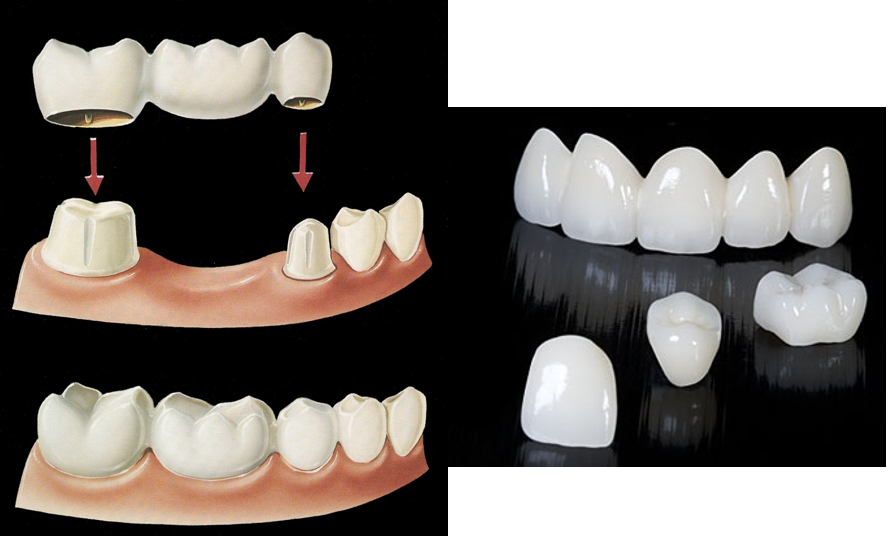
  • Both crowns and  bridges are a fixed prosthesis. Unlike removable dentures, crowns and bridges are permanently fixed.

    How do Crowns Work?
    A crown is used to entirely cover or “cap” a damaged tooth. Besides strengthening a damaged tooth, a crown can be used to improve its color, shape or alignment. A crown can also be placed on top of an implant to provide a tooth-like structure for function. Porcelain or ceramic crowns can be matched to the color of your natural teeth.

    Materials used:

    • Zirconia
    • Porcelain E-max
    • Porcelain fused to metal

    Your dentist may recommend a crown to:

    • Replace a large filling when there isn’t enough tooth remaining
    • Protect a weak tooth from fracturing
    • Restore a fractured tooth
    • Attach a bridge

Dental implants

  • Dental Implant is the first choice of replacing missing teeth as it mimic natural tooth function and aesthetic and maintain bone integrity.
  • Dental implant is a safe procedure and it is biocompatible with body tissue.
  •